The following conversation is a near word-perfect transcription of a typical conversation between me and The Husband as we discuss our days.
THE HUSBAND: You know antifreeze?
MO: Uh... yeah?
TH: I froze it today.
MO: Well, everything freezes eventually.*
TH: We had to run a test at -40 Celsius --
MO: Which is also -40 Fahrenheit!
TH: I know! One time I tried to convert -40C to Fahrenheit in my calculator, and it came back as -40! I did it three times before I realized.
MO: Well, the lines aren't parallel! They have to intersect at some point, right?
TH: Yeah. So anyway, antifreeze freezes at -50F, and we had cooled it so quickly that we overshot -40F, and it froze.
MO: That's pretty cold.
TH: So we're going to run it with ethanol instead, since that freezes below -120C.
MO: Ethanol or ethylene glycol?
TH: Ethanol.
*The Husband helped me remember this conversation, and he maintains that not everything freezes. I said that even hydrogen freezes at absolute zero, and he said no it doesn't. I still think it does, but I suppose he might be right, now that I'm typing this, because I guess that freezing is not the same thing as a cessation of molecular vibration. And yes, I'm typing this footnote as an excuse to write the phrase "cessation of molecular vibration," because I like to show off sometimes.
Showing posts with label engineering. Show all posts
Showing posts with label engineering. Show all posts
Thursday, November 29, 2007


Hi, Honey, I've reentered the domestic habitat
The following conversation is a near word-perfect transcription of a typical conversation between me and The Husband as we discuss our days.
THE HUSBAND: You know antifreeze?
MO: Uh... yeah?
TH: I froze it today.
MO: Well, everything freezes eventually.*
TH: We had to run a test at -40 Celsius --
MO: Which is also -40 Fahrenheit!
TH: I know! One time I tried to convert -40C to Fahrenheit in my calculator, and it came back as -40! I did it three times before I realized.
MO: Well, the lines aren't parallel! They have to intersect at some point, right?
TH: Yeah. So anyway, antifreeze freezes at -50F, and we had cooled it so quickly that we overshot -40F, and it froze.
MO: That's pretty cold.
TH: So we're going to run it with ethanol instead, since that freezes below -120C.
MO: Ethanol or ethylene glycol?
TH: Ethanol.
*The Husband helped me remember this conversation, and he maintains that not everything freezes. I said that even hydrogen freezes at absolute zero, and he said no it doesn't. I still think it does, but I suppose he might be right, now that I'm typing this, because I guess that freezing is not the same thing as a cessation of molecular vibration. And yes, I'm typing this footnote as an excuse to write the phrase "cessation of molecular vibration," because I like to show off sometimes.
THE HUSBAND: You know antifreeze?
MO: Uh... yeah?
TH: I froze it today.
MO: Well, everything freezes eventually.*
TH: We had to run a test at -40 Celsius --
MO: Which is also -40 Fahrenheit!
TH: I know! One time I tried to convert -40C to Fahrenheit in my calculator, and it came back as -40! I did it three times before I realized.
MO: Well, the lines aren't parallel! They have to intersect at some point, right?
TH: Yeah. So anyway, antifreeze freezes at -50F, and we had cooled it so quickly that we overshot -40F, and it froze.
MO: That's pretty cold.
TH: So we're going to run it with ethanol instead, since that freezes below -120C.
MO: Ethanol or ethylene glycol?
TH: Ethanol.
*The Husband helped me remember this conversation, and he maintains that not everything freezes. I said that even hydrogen freezes at absolute zero, and he said no it doesn't. I still think it does, but I suppose he might be right, now that I'm typing this, because I guess that freezing is not the same thing as a cessation of molecular vibration. And yes, I'm typing this footnote as an excuse to write the phrase "cessation of molecular vibration," because I like to show off sometimes.
Thursday, March 08, 2007
Also, don't pour acid directly into your eyes
I'm currently working on a presentation for my company's annual safety training. In every lab safety training I've ever undergone, the trainer or pamphlet always makes a point of saying, "No mouth pipetting." (For the non-sciencey out there, "mouth pipetting" is when you take a little glass or plastic tube, insert one end into a sample of, say, bacterial cell suspension, insert the other end into your mouth, and suck some of the bacterial cell suspension into the tube in order to transfer it to another container.)
And every time I come across that rule written out explicitly, I think to myself, "Who would do that?"
And every time I come across that rule written out explicitly, I think to myself, "Who would do that?"
Tuesday, January 23, 2007
I no longer care about my permanent record
One of the last classes I took in grad school was CAMB 600: Cell and Molecular Biology. It was pretty much a graduate level intro class to cell biology. This was of particular interest to me as the only biology class I took in undergrad was "Biology of Cancer and AIDS" which fulfilled the general education bio requirement without actually being a biology class. You see, my bachelor's degree is in chemical engineering, but it was traditional chemical engineering with no biology at all. I didn't figure out till my senior year that traditional chemical engineering is unbelievably boring. Given that, you might be surprised that my Ph.D. is also in chemical engineering, but I didn't really do chemical engineering research. My thesis was much more cell biology based. Hence, my interest in CAMB 600.
However, given that the only cell biology I knew by that point was what I had taught myself, I was at a slight disadvantage in a class full of BS's in biology. As such, I found the class to be a bit of a struggle and by mid semester I was facing the possibility of a C. This had me worried, because I thought that a class would not count towards my degree unless I got at least a B, and I didn't want to have to take any more classes.
I expressed my concern to The Doktah, and she said, "No, I think that we just have to pass all the classes and maintain an overall GPA of 3.0 or higher, so one C shouldn't keep you from graduating." This was excellent news, but I wanted to be sure and went to see the graduate advisor to double check.
"That's right," he said, "you just need an overall 3.0 or higher."
"That's great!" I said.
"But you don't want to get a C," he warned me.
"Why not?" I said. "What difference will it make?" This class was my last one, and I had already gotten mostly A's, so a C could not possibly lower my GPA to below a 3.0.
The advisor looked a little appalled at my cavalier attitude. "Well, it will not look good on your transcript," he replied.
"But who's going to see my transcript?" I asked. "Do employers want to look at your transcript?"
"Well, no," he said. "But you don't want to get a C!"
I realized the problem. I was talking to a young professor at a major research university, ergo, I was talking to an overachiever. Earning a B would have brought him shame; had he ever gotten a C he probably would have had to commit hara-kiri.
"OK," I said. "I won't get a C."
And I didn't.
However, given that the only cell biology I knew by that point was what I had taught myself, I was at a slight disadvantage in a class full of BS's in biology. As such, I found the class to be a bit of a struggle and by mid semester I was facing the possibility of a C. This had me worried, because I thought that a class would not count towards my degree unless I got at least a B, and I didn't want to have to take any more classes.
I expressed my concern to The Doktah, and she said, "No, I think that we just have to pass all the classes and maintain an overall GPA of 3.0 or higher, so one C shouldn't keep you from graduating." This was excellent news, but I wanted to be sure and went to see the graduate advisor to double check.
"That's right," he said, "you just need an overall 3.0 or higher."
"That's great!" I said.
"But you don't want to get a C," he warned me.
"Why not?" I said. "What difference will it make?" This class was my last one, and I had already gotten mostly A's, so a C could not possibly lower my GPA to below a 3.0.
The advisor looked a little appalled at my cavalier attitude. "Well, it will not look good on your transcript," he replied.
"But who's going to see my transcript?" I asked. "Do employers want to look at your transcript?"
"Well, no," he said. "But you don't want to get a C!"
I realized the problem. I was talking to a young professor at a major research university, ergo, I was talking to an overachiever. Earning a B would have brought him shame; had he ever gotten a C he probably would have had to commit hara-kiri.
"OK," I said. "I won't get a C."
And I didn't.
Tuesday, January 16, 2007
Exploit this
Because I never have any idea what time Jack will take a nap or for how long he will stay asleep, I decided to go back to my roots and start keeping track of what time he eats and sleeps during the day. (At night I am too tired to be bothered; I figure if he sleeps through the night I’ll probably remember.) Basically, I wanted to figure out if he had a nap pattern that I could exploit.
So for ten days, I diligently made a note every time he took a nap or had a meal. I even wrote down for how long he fussed before falling asleep. And then I put all the data into Excel and plotted it. Look, it’s just how I think, OK? I am a very visual learner, and I need to see a graph. (And I thought of a clever way to plot it, if I do say so myself.)
Here’s the plot:

For those of you who are not visual learners, let me briefly interpret the data for you. Do you see those data points on the “Sleeping” axis? Each color represents a different day, and a data point means that Jack was asleep at that time for that day. You may have noticed that there is pretty much a solid line of data points. This means that, for any given minute during the day, Jack has been asleep for at least one day between January 1 and January 10. Well, except for the five minute period highlighted by the yellow circle; he was awake every day during that time for the days represented. Of course, he was asleep at that time yesterday, but I have given up on writing down all the times because there is obviously no point.
So, basically, he has no schedule. He is so anti-schedule that I cannot even guess at how many naps he takes a day, never mind at what time or for how long he will sleep. Oh well, he’s still pretty young, so maybe he’ll settle down into a routine during the next month or two.
So for ten days, I diligently made a note every time he took a nap or had a meal. I even wrote down for how long he fussed before falling asleep. And then I put all the data into Excel and plotted it. Look, it’s just how I think, OK? I am a very visual learner, and I need to see a graph. (And I thought of a clever way to plot it, if I do say so myself.)
Here’s the plot:

For those of you who are not visual learners, let me briefly interpret the data for you. Do you see those data points on the “Sleeping” axis? Each color represents a different day, and a data point means that Jack was asleep at that time for that day. You may have noticed that there is pretty much a solid line of data points. This means that, for any given minute during the day, Jack has been asleep for at least one day between January 1 and January 10. Well, except for the five minute period highlighted by the yellow circle; he was awake every day during that time for the days represented. Of course, he was asleep at that time yesterday, but I have given up on writing down all the times because there is obviously no point.
So, basically, he has no schedule. He is so anti-schedule that I cannot even guess at how many naps he takes a day, never mind at what time or for how long he will sleep. Oh well, he’s still pretty young, so maybe he’ll settle down into a routine during the next month or two.
Tuesday, November 21, 2006
His mother's child
Jack is pretty much a tiny clone of The Husband, so I was pleased to find something he has picked up from me. Yesterday during his naps, I left the radio on for company. Tuned, naturally, to NPR. After he fell asleep in his second nap, I turned off the radio.
He cried.
He cried.
Sunday, November 19, 2006
How many engineers does it take to raise a baby?
I’ve been reading Secrets of the Baby Whisperer by Tracy Hogg, and have therefore been keeping track of what time Jack eats, how long he does an “activity” (such as staring at the black and white picture thingy), when and for how long he sleeps, etc. But I am having trouble actually seeing a pattern to his schedule, and so I decided to input all of my data into Excel so that I can better visualize his behavioral trends.
“What’s the best way to enter the data?” I asked The Husband. “I think I should probably make a column for the time of day in fifteen-minute increments and then have daily columns for ‘Eat,’ ‘Activity,’ and ‘Sleep.’ What do you think?”
“Yeah, that will work,” replied The Husband. “And just put for how many minutes he does each thing at the start time and it will be easy to make a bar graph.”
I’d say the two of us are pretty well matched, wouldn’t you?
“What’s the best way to enter the data?” I asked The Husband. “I think I should probably make a column for the time of day in fifteen-minute increments and then have daily columns for ‘Eat,’ ‘Activity,’ and ‘Sleep.’ What do you think?”
“Yeah, that will work,” replied The Husband. “And just put for how many minutes he does each thing at the start time and it will be easy to make a bar graph.”
I’d say the two of us are pretty well matched, wouldn’t you?
Monday, October 16, 2006
And now, a tale from The Husband’s grad lab
As we are all aware by now, The Husband is also a huge geek. Even geekier than I, as a matter of fact, at least in the traditional sense. He, however, was smart enough to stop his education with a Master’s Degree instead of subjecting himself to the Ph.D. experience.
But this story is not about The Husband. This story is about one of The Husband’s grad school labmates, Clueless. Clueless was in his second year of graduate school, pursuing a Ph.D. in engineering, having already earned a B.S. in engineering. But one afternoon when both Clueless and The Husband were working on a homework assignment for a class they were both taking, Clueless asked The Husband, “What’s a determinant?”
The Husband was mildly surprised that Clueless did not already know, but realized that the concept of “determinant” is not actually very easy, so he figured that Clueless had just forgotten how to calculate them or something and said, “It’s the cross product of the bottom two rows of the matrix, remember?”
“Huh?” Clueless responded. “I don’t know what you are talking about. I’ve never even heard of a determinant.”
For those of you reading this who are not engineers, let me tell you that The Doktah’s jaw has just hit the floor in shock. Because it is impossible to get a degree in engineering without learning about determinants in about nine different classes. They are first introduced in Calculus III, and then they are used in Thermodynamics, Heat and Mass Transfer, Fluid Dynamics, Differential Equations... I could go on. So, while it is possible that someone could graduate with a degree in engineering without understanding determinants – Lord knows I don’t remember what they are used for, just that they are very, very useful – there is no way to get an B.S.E. without having heard of determinants. This was worse than The Husband’s never having heard of Donnie and Marie.
In closing, I will leave you with Webster’s definition of a determinant. I’m sure it will completely explain the concept to you.
de•ter•mi•nant
Pronunciation: di-'t&r-m&-n&nt
Function: noun
2 : a square array of numbers bordered on the left and right by a vertical line and having a value equal to the algebraic sum of all possible products where the number of factors in each product is the same as the number of rows or columns, each factor in a given product is taken from a different row and column, and the sign of a product is positive or negative depending upon whether the number of permutations necessary to place the indices representing each factor's position in its row or column in the order of the natural numbers is odd or even
Got that?
But this story is not about The Husband. This story is about one of The Husband’s grad school labmates, Clueless. Clueless was in his second year of graduate school, pursuing a Ph.D. in engineering, having already earned a B.S. in engineering. But one afternoon when both Clueless and The Husband were working on a homework assignment for a class they were both taking, Clueless asked The Husband, “What’s a determinant?”
The Husband was mildly surprised that Clueless did not already know, but realized that the concept of “determinant” is not actually very easy, so he figured that Clueless had just forgotten how to calculate them or something and said, “It’s the cross product of the bottom two rows of the matrix, remember?”
“Huh?” Clueless responded. “I don’t know what you are talking about. I’ve never even heard of a determinant.”
For those of you reading this who are not engineers, let me tell you that The Doktah’s jaw has just hit the floor in shock. Because it is impossible to get a degree in engineering without learning about determinants in about nine different classes. They are first introduced in Calculus III, and then they are used in Thermodynamics, Heat and Mass Transfer, Fluid Dynamics, Differential Equations... I could go on. So, while it is possible that someone could graduate with a degree in engineering without understanding determinants – Lord knows I don’t remember what they are used for, just that they are very, very useful – there is no way to get an B.S.E. without having heard of determinants. This was worse than The Husband’s never having heard of Donnie and Marie.
In closing, I will leave you with Webster’s definition of a determinant. I’m sure it will completely explain the concept to you.
de•ter•mi•nant
Pronunciation: di-'t&r-m&-n&nt
Function: noun
2 : a square array of numbers bordered on the left and right by a vertical line and having a value equal to the algebraic sum of all possible products where the number of factors in each product is the same as the number of rows or columns, each factor in a given product is taken from a different row and column, and the sign of a product is positive or negative depending upon whether the number of permutations necessary to place the indices representing each factor's position in its row or column in the order of the natural numbers is odd or even
Got that?
Monday, October 02, 2006
Differential what now?
For those of you here for the stories about home remodeling and pregnancy, let me explain that the field of engineering pretty much boils down to the solving of differential equations. You might therefore expect that, as someone who holds a Ph.D. in engineering, I would be capable of solving differential equations. You would be mistaken.
For a Ph.D. engineer, my math is actually pretty weak, despite the fancy equations I posted in this entry. (Some might argue, in fact, that this series of entries is actually evidence of my poor math skills, but I’m not going down that road again.) My professors can be held partly responsible for my poor math skills, because in college, my engineering professors always provided us with the solutions to the relevant differential equations instead of making us solve them ourselves. They were relying on the math department to teach us to solve the equations. Unfortunately, my math professors were pretty awful. For example, I took a class in linear algebra, taught by a Russian guy with a heavy accent. He typically started the class by writing an equation on the board and asking, “What do you think x is?”
There would be a pause, and someone would say, “Um, 1?”
“Let’s try that,” he say, and then he’d substitute 1 in for x and see if it worked out. If he ended up with something like “1=4,” he’d say, “No, 1 didn’t work. Anyone else?” Someone would suggest he try x=0, and the process would repeat. I assume that he eventually transitioned into the actual technique for solving the equation, but he never really told us when that transition occurred. So, as far as I could tell, he was teaching us to solve linear algebra equations by randomly guessing what x equals until finding something that worked. That is a pretty poor technique, as only good luck would ensure that the solution is found without having to test infinity numbers. Which would take a while.
In grad school, my engineering professors once again provided us with the solutions to all the relevant differential equations, so once again I didn’t have to know how to solve them. There was one grad school class where we were taught how to solve partial differential equations, but not really. The professor taught us the “separation of variables” technique, which is all fine and dandy if you can separate the variables. Sadly, for most real-life engineering problems, you can’t. So for most real-life engineering problems, you have to solve the differential equation numerically. (Ironically, solving an equation numerically is almost like solving an equation by randomly guessing what x equals, but using a computer so there is a chance that you will arrive at the solution in your lifetime.) Our professor taught us one numerical technique called “the finite difference method,” but he didn’t do a great job teaching us. What he did was give us a computer program which used the finite difference method to solve an equation. Then, as an assignment, he told us to use the program to solve the equation for different initial conditions. Someone asked him how many sets of initial conditions we needed to try. “At least one,” he said.
Ah.
The Doktah and I used to joke about what would happen if someone asked us how to solve a partial differential equation. “Did you try separating the variables? Oh, you can’t separate them? I can’t help you.”
But no matter how lax my professors were in teaching me how to solve differential equations, I can’t lay all the blame on them. I was in college and graduate school for nine years, so it’s possible that I should have taken some of the responsibility for my own education. Perhaps I should have taken the initiative to, oh, read about the finite difference method and actually learn it instead of just changing the initial conditions of our professor’s problem and calling it done. Because in the end, I hurt only myself.
Or did I? Because ask me how often someone asks me to solve differential equations these days. I’ll tell you. Not a lot. The skills I learned during my interminable years in college and graduate school that I actually use in my daily life are more of the critical data analysis and presentation variety and less of the higher math sort. In fact, the types of experiments I do now at work barely even resemble anything I learned in college or grad school. It most definitely is not engineering, and never requires that I solve differential equations. However, my engineering background serves me well in my ability to get to the crux of the problem at hand and in my willingness to try creative approaches in solving it.
That’s got to be worth something, right?
For a Ph.D. engineer, my math is actually pretty weak, despite the fancy equations I posted in this entry. (Some might argue, in fact, that this series of entries is actually evidence of my poor math skills, but I’m not going down that road again.) My professors can be held partly responsible for my poor math skills, because in college, my engineering professors always provided us with the solutions to the relevant differential equations instead of making us solve them ourselves. They were relying on the math department to teach us to solve the equations. Unfortunately, my math professors were pretty awful. For example, I took a class in linear algebra, taught by a Russian guy with a heavy accent. He typically started the class by writing an equation on the board and asking, “What do you think x is?”
There would be a pause, and someone would say, “Um, 1?”
“Let’s try that,” he say, and then he’d substitute 1 in for x and see if it worked out. If he ended up with something like “1=4,” he’d say, “No, 1 didn’t work. Anyone else?” Someone would suggest he try x=0, and the process would repeat. I assume that he eventually transitioned into the actual technique for solving the equation, but he never really told us when that transition occurred. So, as far as I could tell, he was teaching us to solve linear algebra equations by randomly guessing what x equals until finding something that worked. That is a pretty poor technique, as only good luck would ensure that the solution is found without having to test infinity numbers. Which would take a while.
In grad school, my engineering professors once again provided us with the solutions to all the relevant differential equations, so once again I didn’t have to know how to solve them. There was one grad school class where we were taught how to solve partial differential equations, but not really. The professor taught us the “separation of variables” technique, which is all fine and dandy if you can separate the variables. Sadly, for most real-life engineering problems, you can’t. So for most real-life engineering problems, you have to solve the differential equation numerically. (Ironically, solving an equation numerically is almost like solving an equation by randomly guessing what x equals, but using a computer so there is a chance that you will arrive at the solution in your lifetime.) Our professor taught us one numerical technique called “the finite difference method,” but he didn’t do a great job teaching us. What he did was give us a computer program which used the finite difference method to solve an equation. Then, as an assignment, he told us to use the program to solve the equation for different initial conditions. Someone asked him how many sets of initial conditions we needed to try. “At least one,” he said.
Ah.
The Doktah and I used to joke about what would happen if someone asked us how to solve a partial differential equation. “Did you try separating the variables? Oh, you can’t separate them? I can’t help you.”
But no matter how lax my professors were in teaching me how to solve differential equations, I can’t lay all the blame on them. I was in college and graduate school for nine years, so it’s possible that I should have taken some of the responsibility for my own education. Perhaps I should have taken the initiative to, oh, read about the finite difference method and actually learn it instead of just changing the initial conditions of our professor’s problem and calling it done. Because in the end, I hurt only myself.
Or did I? Because ask me how often someone asks me to solve differential equations these days. I’ll tell you. Not a lot. The skills I learned during my interminable years in college and graduate school that I actually use in my daily life are more of the critical data analysis and presentation variety and less of the higher math sort. In fact, the types of experiments I do now at work barely even resemble anything I learned in college or grad school. It most definitely is not engineering, and never requires that I solve differential equations. However, my engineering background serves me well in my ability to get to the crux of the problem at hand and in my willingness to try creative approaches in solving it.
That’s got to be worth something, right?
Wednesday, September 20, 2006
If all you care about is The Bathroom Remodel, skip this post
The Doktah called me at work the other day and left me a message with an example of a limit where “plugging in infinity” didn’t work. At first, I thought she was right, and I wasn’t going to blog about it because it would mean I was wrong, and it’s my blog, so I don’t have to admit to being wrong if I don’t want to. But it bugged me all day, so I looked it up in my Calculus book when I got home that night.
I’m still right.
Her example:

Now, if you plug in infinity for L, you get

This appears to reduce to ∞/∞ = 1.
But! One thing that I admit to sort of forgetting because I don’t actually take limits anymore is that ∞/∞ is undefined. So while you can cancel ∞2/∞ to get ∞, you can’t cancel ∞/∞ to get 1. You have to use L’Hopital’s rule*. But back in the day when I used to take limits on a regular basis, this never bothered me or made me get any wrong answers in my problem sets because I knew the rule. Anytime you get an undefined solution like ∞/∞ or ∞/0 (or anything over 0, for that matter), you have to take another step to solve the problem.
So, nyah nyah.
*L’Hopital’s rule just says that the limit of the derivatives of each term in the function is the same as the limit of the function, so you just take limit of the derivatives of the separate terms until you get something that is defined. I put this explanation in a footnote because I would bet that 90% of my readers didn’t even read to the end of this entry because it is full of equations. I can’t really blame them.
I’m still right.
Her example:
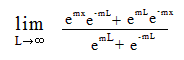
Now, if you plug in infinity for L, you get

This appears to reduce to ∞/∞ = 1.
But! One thing that I admit to sort of forgetting because I don’t actually take limits anymore is that ∞/∞ is undefined. So while you can cancel ∞2/∞ to get ∞, you can’t cancel ∞/∞ to get 1. You have to use L’Hopital’s rule*. But back in the day when I used to take limits on a regular basis, this never bothered me or made me get any wrong answers in my problem sets because I knew the rule. Anytime you get an undefined solution like ∞/∞ or ∞/0 (or anything over 0, for that matter), you have to take another step to solve the problem.
So, nyah nyah.
*L’Hopital’s rule just says that the limit of the derivatives of each term in the function is the same as the limit of the function, so you just take limit of the derivatives of the separate terms until you get something that is defined. I put this explanation in a footnote because I would bet that 90% of my readers didn’t even read to the end of this entry because it is full of equations. I can’t really blame them.
Friday, August 04, 2006
The saga continues
I was just checking my stats, and someone found my site through a Google search of "infinity cancel out."
Hee.
Hee.
Thursday, August 03, 2006
Canceling infinity - posted sort of late
I don't know why I never posted this back when I wrote it in October, but I'm posting it now.
Surprisingly, my post about taking limits hit almost as many nerves as the ones about Dunkin' Donuts. Anonymous, for example, got all up in my grill and may have called me stupid, but I can't be sure because his/her comment is unclear. And, amusingly, my friend told me that when she read the post to her husband, he, too, got all upset about my "plugging in" and "canceling" infinity. Because you can't! You can't cancel infinity! What about the limit of sin(x)/x as x approaches 0?, hmm? WHAT THEN? ("Yeah!" The Husband is probably shouting as he reads this.)
So, yeah, Friend's Husband has a point. Sometimes you have to use L'Hopital's rule first. But eventually, just plug in infinity and roll with it.
Surprisingly, my post about taking limits hit almost as many nerves as the ones about Dunkin' Donuts. Anonymous, for example, got all up in my grill and may have called me stupid, but I can't be sure because his/her comment is unclear. And, amusingly, my friend told me that when she read the post to her husband, he, too, got all upset about my "plugging in" and "canceling" infinity. Because you can't! You can't cancel infinity! What about the limit of sin(x)/x as x approaches 0?, hmm? WHAT THEN? ("Yeah!" The Husband is probably shouting as he reads this.)
So, yeah, Friend's Husband has a point. Sometimes you have to use L'Hopital's rule first. But eventually, just plug in infinity and roll with it.
Wednesday, July 19, 2006
Noooooooooooooo!
It was the same night that my study group member wanted to use the Peng-Robinson equation to solve the problem involving carbon dioxide. We had been working on Thermo II homework for hours and hours, and we were getting way too punchy to keep it up. So we decided that, finished or not, we would stop working at midnight.
Sure enough, when 11:59 pm rolled around, not much was getting accomplished as each of us sat and stared at the clock waiting for the magical witching hour.
At 11:59:45, the clock stopped.
Then the second hand started to sweep backwards.
We left anyway.
Sure enough, when 11:59 pm rolled around, not much was getting accomplished as each of us sat and stared at the clock waiting for the magical witching hour.
At 11:59:45, the clock stopped.
Then the second hand started to sweep backwards.
We left anyway.
Thursday, July 13, 2006
Trust me, the idea of using the Peng-Robinson equation is hilarious
Along the lines of this post, I recall a time when my college study group was working on a problem set for Thermodynamics II (class motto: Remember Thermo I? This is worse!). We were trying to solve some question that involved a gas like carbon dioxide or something. It was getting pretty late, and we were all a little punchy. I said, “Well, if we use the ideal gas law, then PV=nRT.”
One of the study group members replied, “But carbon dioxide isn’t really an ideal gas.”
This was an issue that had come up in my group before; you see, the ideal gas law applies to, you guessed it, ideal gases. Which don’t technically exist. But it’s a reasonable approximation and the ideal gas law is the simplest equation to work with, and it was nearly midnight and we had been working on this problem set for hours. So I said to him, “Well, you can use the Peng-Robinson equation if you want to, but I am going to assume it’s an ideal gas.”
Oh, how we laughed.
And then we may have cried a little bit.
One of the study group members replied, “But carbon dioxide isn’t really an ideal gas.”
This was an issue that had come up in my group before; you see, the ideal gas law applies to, you guessed it, ideal gases. Which don’t technically exist. But it’s a reasonable approximation and the ideal gas law is the simplest equation to work with, and it was nearly midnight and we had been working on this problem set for hours. So I said to him, “Well, you can use the Peng-Robinson equation if you want to, but I am going to assume it’s an ideal gas.”
Oh, how we laughed.
And then we may have cried a little bit.
Wednesday, July 12, 2006
This entry is good enough, right?
A friend of mine who just recently finished her Master’s degree told me that in the last class she took, her teacher gave her special instructions for an assignment. She was to do the minimum amount of work required to complete the project, and that was it. No delving into anything that wasn’t absolutely necessary.
I found this fascinating, because no teacher of mine would tell me to do that. They wouldn’t have to. That’s how I operate. Oh, I think that maybe in high school I worked harder than necessary, but once I got to college everything changed. I think it’s because I no longer had time to put that extra special something on homework assignments. Sure, I would probably have learned more if I actually read the chapter before doing the problem set instead of using the time-honored technique of randomly flipping through the chapter to find the right equation to solve it. But I would only have learned more in one of my classes because I would have flunked out of my other classes thanks to not finishing any of the problem sets.
See, engineering is hard. I say this not to put down other disciplines. In no way am I trying to compare the challenges of earning an engineering degree with those of other degree programs. I never had to read fifteen books a week for a comparative literature class for example, and neither did I have to pass an oral exam in a foreign language. So I can only draw from my own experience and say that the course load and work required for an engineering degree can be quite overwhelming, and the only way I could get through it was by doing only what was required of me, and no extra.
But, hey, you could argue that that is the whole philosophy of engineering anyway. Who but an engineer would model a horse as a sphere with four cylinders in order to estimate the volume?
I found this fascinating, because no teacher of mine would tell me to do that. They wouldn’t have to. That’s how I operate. Oh, I think that maybe in high school I worked harder than necessary, but once I got to college everything changed. I think it’s because I no longer had time to put that extra special something on homework assignments. Sure, I would probably have learned more if I actually read the chapter before doing the problem set instead of using the time-honored technique of randomly flipping through the chapter to find the right equation to solve it. But I would only have learned more in one of my classes because I would have flunked out of my other classes thanks to not finishing any of the problem sets.
See, engineering is hard. I say this not to put down other disciplines. In no way am I trying to compare the challenges of earning an engineering degree with those of other degree programs. I never had to read fifteen books a week for a comparative literature class for example, and neither did I have to pass an oral exam in a foreign language. So I can only draw from my own experience and say that the course load and work required for an engineering degree can be quite overwhelming, and the only way I could get through it was by doing only what was required of me, and no extra.
But, hey, you could argue that that is the whole philosophy of engineering anyway. Who but an engineer would model a horse as a sphere with four cylinders in order to estimate the volume?
Friday, May 05, 2006
German theory
In response to Banalities comment on this post, I am inspired to tell a story about when I worked in Germany for a summer. See, I don't speak German (although I did learn to say "Excuse me," "I'm sorry," "I don't understand," "I don't speak German," and "Where is the bathroom," among other key phrases), but there was a sign in the lab where I worked that I was able to translate. I glance at it, and then chuckled to myself. The Germans, surprised, said, "You understand that?"
"Sure," I said. And I read, "In this lab we have both theory and practice. Nothing works, and no one knows why!"
It wasn't really that amazing of a feat, though, because I had learned the words for "know," and "work," and the German words for "theory" and "practice" are something like "theorin" and "praktica." (I'm just making those up, so don't jump down my throat if they are wrong, which they are.) But the point is, I could guess from context at the meaning.
Being in Germany was interesting. I found out what it was like to be illiterate. It's not fun. Sure, I could tell that the box in the grocery store was soap, but was it bath soap? Dish soap? Laundry soap? Who knew? And I knew the sign with a picture of a bike on it was telling me that something was verboten, but I couldn't tell if I was not allowed to walk on the bike path or if I was forbidden from riding my bike on the pedestrian path. Critical distinction, there.
It was a fun experience, all in all. And by spending three weeks in Germany made me much less afraid to try speaking French when I went to Paris for a long weekend. Sure, my accent was horrible and my grammar was faulty, but at least I had a shot.
"Sure," I said. And I read, "In this lab we have both theory and practice. Nothing works, and no one knows why!"
It wasn't really that amazing of a feat, though, because I had learned the words for "know," and "work," and the German words for "theory" and "practice" are something like "theorin" and "praktica." (I'm just making those up, so don't jump down my throat if they are wrong, which they are.) But the point is, I could guess from context at the meaning.
Being in Germany was interesting. I found out what it was like to be illiterate. It's not fun. Sure, I could tell that the box in the grocery store was soap, but was it bath soap? Dish soap? Laundry soap? Who knew? And I knew the sign with a picture of a bike on it was telling me that something was verboten, but I couldn't tell if I was not allowed to walk on the bike path or if I was forbidden from riding my bike on the pedestrian path. Critical distinction, there.
It was a fun experience, all in all. And by spending three weeks in Germany made me much less afraid to try speaking French when I went to Paris for a long weekend. Sure, my accent was horrible and my grammar was faulty, but at least I had a shot.
Friday, December 09, 2005
Motherly instinct
I work with tissue cells, and they require a lot of care and attention. I’ve often said that taking care of cells is almost like taking care of a baby. Except that when the cells die, you just say, “Oh, well,” and throw away the dish.
Saturday, November 26, 2005
How does this work?
I get a lot of, “Hey, Mo, you’re an engineer. How does a car work? How do you hang these blinds? How many bugs are there in the world? Which way do the exits go on the Mass Pike?”
But the other day, Brother-in-law #4 asked me a question. He said, “Hey, Mo, you’re an engineer, right?” I braced myself for the inevitable question about something completely unrelated to chemical engineering. But instead he said, “If I put my water bottle in the freezer, it will cool down faster than if I put it in the refrigerator, right?”
What? What was this? A question about temperature? About heat transfer? But... but... that’s the kind of engineer I am!
Sadly, it’s actually only the kind of engineer I used to be, and I couldn’t remember the correct answer.
But the other day, Brother-in-law #4 asked me a question. He said, “Hey, Mo, you’re an engineer, right?” I braced myself for the inevitable question about something completely unrelated to chemical engineering. But instead he said, “If I put my water bottle in the freezer, it will cool down faster than if I put it in the refrigerator, right?”
What? What was this? A question about temperature? About heat transfer? But... but... that’s the kind of engineer I am!
Sadly, it’s actually only the kind of engineer I used to be, and I couldn’t remember the correct answer.
Tuesday, November 08, 2005
Technology is making me stupid
Today I needed to calculated how much serum I needed to get 100 mL of a solution that was 3% serum. I dutifully keyed “0.03x100” into my calculator. Guess what the answer was!
Thursday, September 22, 2005
When geeks argue
The Husband and I have an argument that has been ongoing since college. You see, I was telling him about learning how to do limits in my high school calculus class. I developed a technique for understanding what to do when x approaches infinity: Plug in infinity for x, cross off any terms that are added to or subtracted from infinity, and then cancel an things out just like you would for any other number. For example, the limit as x approaches infinity for (2x+1)/x is 2. How do I know? Plug infinity in for x. Drop the 1 and in the numerator, because 1 is nothing compared to infinity. You’re left with 2x/x, or two times infinity divided by infinity. Cancel the infinities, and bam! The answer is 2.
When I told my high school calculus teacher how I was doing these limits, he got all upset and said, “You can’t ‘cancel out’ infinity. Infinity is not a number.”
“But it works every time,” I said. “It’s what you were doing in the examples, you just weren’t saying ‘cancel out the infinities.’”
He cast around for a decent response to this simple fact, and said, “Well, fine, but just don’t say you’re ‘plugging in’ and ‘canceling out’ infinity.” I agreed to not say it aloud, but that is how I do limits and how I will always do limits. Because it works every time! And it makes perfect sense to me.
Enter The Husband. Somehow, limits came up as a topic of our conversation. (This is not so bizarre given that we are both in professions that actually require us to take limits sometimes. I know! People really do it!) And when I told The Husband about my conversation with my calculus teacher, he, too, got all upset.
“You’re teacher was right. You can’t ‘plug in’ infinity,” he said, exasperated. “Infinity is not a number!”
“But it works every single time!” I said. “It’s just semantics, here. That’s what you do too. You cancel out infinity when you have infinity over infinity, you just don’t call it that.”
I tried to demonstrate my point by going through some examples of taking limits, but The Husband just got fed up with me every time I got to infinity over infinity. Eventually, the conversation degraded into name-calling.
To this day, if I want to get The Husband’s dander up, I just mention that I’m planning to “cancel out the infinities."
When I told my high school calculus teacher how I was doing these limits, he got all upset and said, “You can’t ‘cancel out’ infinity. Infinity is not a number.”
“But it works every time,” I said. “It’s what you were doing in the examples, you just weren’t saying ‘cancel out the infinities.’”
He cast around for a decent response to this simple fact, and said, “Well, fine, but just don’t say you’re ‘plugging in’ and ‘canceling out’ infinity.” I agreed to not say it aloud, but that is how I do limits and how I will always do limits. Because it works every time! And it makes perfect sense to me.
Enter The Husband. Somehow, limits came up as a topic of our conversation. (This is not so bizarre given that we are both in professions that actually require us to take limits sometimes. I know! People really do it!) And when I told The Husband about my conversation with my calculus teacher, he, too, got all upset.
“You’re teacher was right. You can’t ‘plug in’ infinity,” he said, exasperated. “Infinity is not a number!”
“But it works every single time!” I said. “It’s just semantics, here. That’s what you do too. You cancel out infinity when you have infinity over infinity, you just don’t call it that.”
I tried to demonstrate my point by going through some examples of taking limits, but The Husband just got fed up with me every time I got to infinity over infinity. Eventually, the conversation degraded into name-calling.
To this day, if I want to get The Husband’s dander up, I just mention that I’m planning to “cancel out the infinities."
Subscribe to:
Posts (Atom)
